


AI-Powered Fabric Defect Detection: Smarter Quality Control for Textile Manufacturers
In modern textile manufacturing, maintaining consistent product quality has become more challenging than ever. Even a small fabric defect can lead to rejected shipments, customer dissatisfaction, production delays, and increased operational costs.
As textile manufacturers across the United States, Canada, India, the Middle East, and rapidly growing African manufacturing markets continue to scale production, traditional manual inspection methods are struggling to keep up with modern quality expectations.
This shift is driving the adoption of AI-powered fabric defect detection systems that help manufacturers automate inspection, reduce waste, and improve production efficiency.
DefectGuard by Brightpoint Infotech brings a practical AI-driven approach to textile quality inspection using computer vision, deep learning, and real-time analytics.

Why Fabric Defects Continue to Impact Textile Manufacturing
Fabric defects are one of the most common operational challenges in textile production. These issues can occur at multiple stages of manufacturing, including weaving, spinning, dyeing, finishing, and handling.
Common causes include:
Machine faults
Faulty yarns
Improper stretching
Material inconsistencies
Production handling errors
The textile industry recognizes more than 70 types of defects, including:
Slubs
Holes
Floats
Rust stains
Weft curling
Stitching defects
Surface irregularities
Pattern inconsistencies
Even minor defects can significantly reduce fabric quality and market value.
For manufacturers operating in competitive global markets, inconsistent quality directly impacts profitability, customer trust, and export standards.
The Limitations of Manual Fabric Inspection
For years, manual inspection has been the standard method for textile quality control. However, modern production environments demand faster and more accurate inspection processes.
Manual inspection introduces several operational limitations.
Human Fatigue and Inconsistency: Inspectors working continuously on high-speed production lines can easily miss subtle defects due to fatigue and reduced concentration.
This often results in inconsistent inspection quality across production batches.
Difficulty Detecting Minor Defects: Small defects, texture abnormalities, and complex pattern irregularities are difficult to identify manually, especially in high-volume textile production.
Slower Inspection Processes: Manual quality checks can create production bottlenecks that slow down manufacturing cycles and increase operational inefficiencies.
As production speeds continue to increase, traditional inspection methods are becoming less practical for modern textile factories.
How AI-Powered Fabric Defect Detection Works
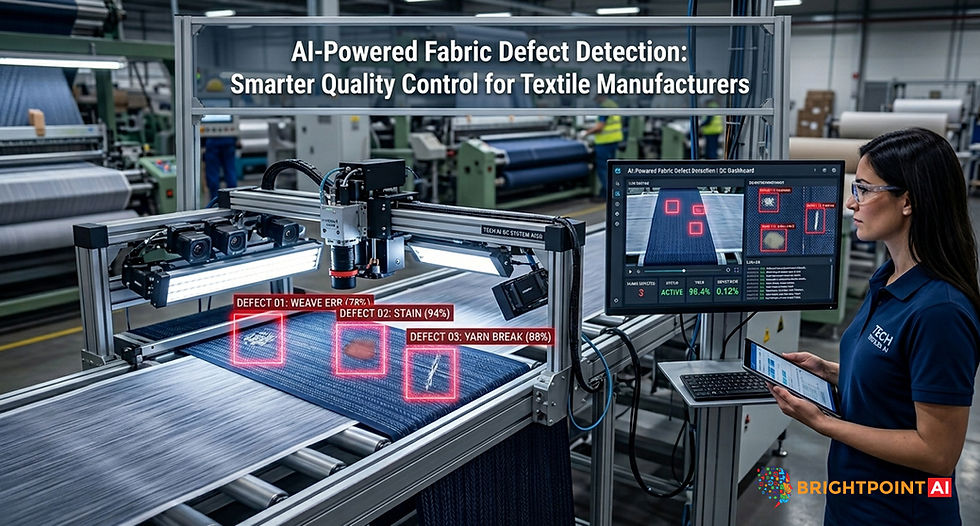
AI-powered textile inspection systems use computer vision and deep learning technologies to automatically inspect fabrics during production.
High-resolution cameras continuously capture fabric images directly from production lines while AI algorithms analyze patterns, textures, and surface quality in real time.
This allows manufacturers to detect defects immediately before they impact larger production batches.
AI and Computer Vision in Textile Manufacturing
Modern AI inspection systems use advanced convolutional neural networks (CNNs) trained on thousands of fabric defect samples.
These deep learning models can identify:
Surface defects
Pattern distortions
Texture inconsistencies
Structural irregularities
Color variations
Weaving issues
Unlike manual inspection, AI systems continuously learn and improve from operational data, increasing accuracy over time.
This makes AI-powered inspection highly effective for:
Textile mills
Garment manufacturers
Denim production units
Knitted fabric factories
Industrial textile manufacturing
Technical textile production
Why DefectGuard Is Built for Textile and Manufacturing Industries
Unlike generic inspection tools, DefectGuard by Brightpoint Infotech is specifically designed for textile and manufacturing environments where speed, consistency, and quality are critical.
The solution combines AI, computer vision, and deep learning technologies to help manufacturers automate fabric inspection and improve production quality across high-speed manufacturing lines.
DefectGuard is highly effective for:
Textile mills
Garment production facilities
Fabric processing units
Industrial manufacturing plants
Automated quality inspection operations
The platform supports:
Real-time defect detection
AI-powered visual inspection
Automated defect classification
Predictive quality monitoring
Cloud and edge deployment
What makes DefectGuard especially valuable for textile manufacturers is its ability to detect complex defects such as:
Holes
Slubs
Stitching defects
Surface damage
Pattern irregularities
Fabric inconsistencies
Using advanced AI models, the system continuously improves detection accuracy while reducing dependency on repetitive manual inspection processes.
Real-Time Inspection for Faster Production Decisions
One of the biggest advantages of AI-powered inspection is real-time defect detection.
As fabric moves through the production line, DefectGuard instantly identifies defects and alerts operators immediately.
This allows manufacturers to:
Stop defective batches earlier
Reduce material waste
Improve production efficiency
Prevent quality issues from spreading further into operations
Real-time monitoring helps textile factories reduce costly rework and improve overall operational performance.
Key Benefits of AI-Based Textile Inspection Systems
Improved Quality Control: AI inspection delivers highly accurate and consistent quality monitoring across large production volumes.
Manufacturers can maintain standardized product quality while minimizing inspection errors.
Reduced Waste and Rework: Early defect detection prevents defective materials from progressing further through production.
This reduces:
Fabric waste
Reprocessing costs
Shipment rejections
Production losses
Faster Manufacturing Cycles
Automated inspection systems eliminate delays associated with manual quality checks.
Manufacturers can improve production speed without compromising quality.
Better Resource Utilization
AI-powered inspection reduces repetitive manual tasks, allowing skilled workers to focus on more valuable operational activities.
Scalability Across Multiple Fabric Types
DefectGuard supports various textile categories including:
Woven fabrics
Knitted textiles
Printed fabrics
Technical textiles
Industrial materials
This flexibility makes the system suitable for diverse manufacturing environments.
From Defect Detection to Intelligent Manufacturing Insights
Modern AI inspection solutions do more than detect defects. They also provide manufacturers with actionable production intelligence.
DefectGuard helps manufacturers analyze operational data through:
Trend tracking
Root cause analysis
Predictive maintenance insights
Production performance monitoring
Process optimization reporting
Manufacturers can identify recurring quality issues, detect machine performance problems early, and improve operational efficiency using real production data.
This supports the transition toward Industry 4.0 and smart manufacturing.
Flexible Deployment for Modern Manufacturing Operations
DefectGuard supports flexible deployment models designed for modern industrial environments.
Cloud Deployment
Ideal for centralized monitoring, scalability, and multi-location operations.
Edge and On-Premise Deployment
Enables low-latency processing directly inside manufacturing facilities for faster real-time decision-making.
Secure Infrastructure
Built with secure architecture to ensure operational data privacy and protection.
Why Textile Manufacturers Worldwide Are Adopting AI Inspection?
Textile manufacturers across South Africa, Kenya, Nigeria, and Egypt are increasingly investing in AI-powered manufacturing technologies to remain competitive in global markets.
The key drivers include:
Rising customer quality expectations
Increasing operational costs
Demand for faster production
Need for export-quality standards
Pressure to reduce waste and downtime
Manufacturers adopting AI inspection systems gain advantages through:
Higher product quality
Reduced operational inefficiencies
Faster production output
Improved profitability
Better production consistency
The Future of AI in Textile Manufacturing
The future of textile manufacturing is increasingly connected to intelligent automation, predictive analytics, and AI-powered quality control systems.
As AI technologies continue evolving, textile manufacturers will be able to:
Predict defects before failures occur
Improve machine efficiency automatically
Reduce operational downtime
Enhance production sustainability
Optimize manufacturing workflows
AI-powered quality management is no longer just a technology upgrade — it is becoming a competitive necessity for modern manufacturing operations.
Frequently Asked Questions
Q1. What is AI-powered fabric defect detection?
Ans. AI-powered fabric defect detection uses artificial intelligence, computer vision, and deep learning to automatically identify fabric defects during textile manufacturing.
Q2. How does AI improve textile quality control?
Ans. AI systems analyze fabric patterns and textures in real time, helping manufacturers detect defects faster and more accurately than manual inspection methods.
Q3. Can AI detect defects in patterned fabrics?
Ans. Yes. Advanced deep learning models can identify subtle irregularities even in complex patterns, textures, and printed fabrics.
Q4. Which industries can use AI inspection systems?
Ans. AI-powered inspection systems are useful for:
Textile manufacturing
Garment production
Industrial manufacturing
Technical textile production
Fabric processing industries
Q5. What are the benefits of automated textile inspection?
Ans. Benefits include:
Improved quality control
Reduced waste
Faster inspection
Lower operational costs
Better production efficiency
Final Thoughts
Quality control in textile manufacturing is evolving from reactive inspection to proactive quality management.
AI-powered solutions like DefectGuard help manufacturers reduce defects, automate quality inspection, improve operational efficiency, and make smarter production decisions using real-time analytics.
As global manufacturing competition continues to increase, companies adopting intelligent AI inspection systems will be better positioned to deliver higher-quality products consistently and profitably.
Discover how DefectGuard by Brightpoint Infotech helps textile manufacturers automate inspection, reduce fabric defects, and improve production efficiency with AI-powered quality control solutions.
👉 Schedule a live demo to see DefectGuard in action.


Comments